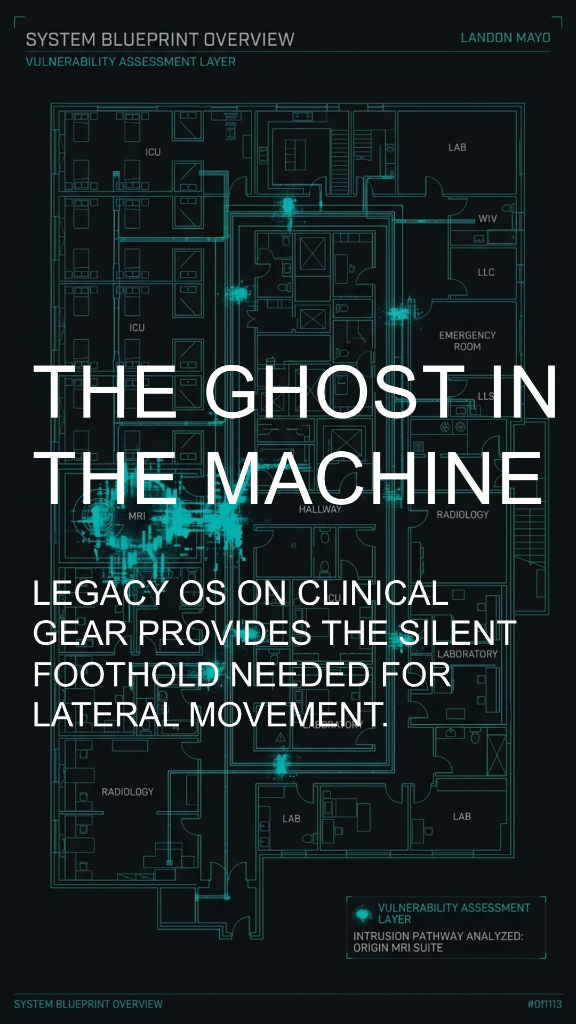
1. Introduction: The 2026 Healthcare Cybersecurity Paradox
The healthcare landscape of 2026 is defined by a profound operational paradox. Clinical environments represent the pinnacle of technological advancement, deploying robotic surgery, precision medicine, and a hyper-connected Internet of Medical Things (IoMT) [6, 9]. However, this cutting-edge surface rests upon a decaying digital foundation characterized by "digital debt"—a massive accumulation of legacy operating systems, deprecated protocols, and aging hardware [6].
Nearly a decade after its public release, the MS17-010 vulnerability, or "EternalBlue," remains the epicenter of this infrastructure crisis [6]. While other critical sectors have largely eradicated this flaw through aggressive lifecycle management, healthcare remains a primary target. The persistence of this single exploit dictates the operational resilience of modern healthcare delivery organizations (HDOs), effectively acting as a "ghost in the machine" that continues to facilitate catastrophic systemic failures [6].
2. Technical Anatomy: The Mechanics of MS17-010
EternalBlue is a sophisticated exploit originally developed by the U.S. National Security Agency (NSA) that targets a family of critical Remote Code Execution (RCE) vulnerabilities in Microsoft’s Server Message Block version 1 (SMBv1) protocol, tracked as CVE-2017-0143 through CVE-2017-0148 [6].
The technical mechanism involves a logic flaw in how the SMBv1 server handles specially crafted packets over TCP port 445 [3]. By sending these malicious packets, an attacker can manipulate the file server's memory allocation, triggering a kernel-level buffer overflow [6]. This allows for the execution of arbitrary code with complete system privileges, effectively bypassing standard user-level security controls [6].
Evolution of the SMB Protocol
The following table highlights the security advancements in SMB iterations and the vulnerability risks associated with maintaining backward compatibility for legacy medical devices.
| SMB Version | Date | Key Security Advancements | Security Risk Profile |
|---|---|---|---|
| SMBv1 | 1984 | None; designed for trusted local networks. | Inherently insecure; target of MS17-010 [6]. |
| SMBv2.0 | 2006 | Reduced "chattiness"; optimized for large files. | Lacks modern encryption standards [6]. |
| SMBv2.1 | 2008 | Introduced opportunistic locking for performance. | Still susceptible to legacy protocol exploits [6]. |
| SMBv3.0 | 2012 | Introduced end-to-end encryption. | Vulnerable if backward compatibility is enabled [6]. |
| SMBv3.1.1 | 2016 | SHA-512 pre-auth checks; AES encryption. | Most secure; requires modern hardware/OS [6]. |
The exploit is notoriously "wormable," requiring zero user interaction to propagate [6]. Once a foothold is established, it typically deploys the DoublePulsar backdoor as a secondary payload, providing a covert communication channel for remote control and further malware injection, such as ransomware [3, 6].
3. The Healthcare Ecosystem of Fragility
Healthcare is uniquely susceptible to legacy exploits due to the extended lifecycle of medical technology. Critical devices—including MRI machines, CT scanners, and infusion pumps—often have operational lifespans of 10 to 30 years [8]. This far exceeds the support cycles of the embedded Windows operating systems (such as XP or 7) that power them [6].
The 2026 Statistical Landscape
- 73%: Percentage of healthcare providers relying on legacy information systems in production [6].
- 6.2: The average number of vulnerabilities identified per connected medical device [8].
- 53%: Percentage of connected IoMT devices in hospitals with known critical vulnerabilities [8].
This fragility is driven by the Capital Expenditure Paradox: hospital boards frequently authorize millions for revenue-generating clinical hardware but remain reluctant to fund the underlying network infrastructure required to secure it [6]. Consequently, coverage for medical device security and supply chain risk management remains stalled at approximately 50%, leaving half of a hospital’s technological assets in a security blind spot [6].
4. A Chronology of Catastrophe: Documented Incidents (2017–2024)
Threat actors consistently leverage MS17-010 and related lateral movement techniques to paralyze hospital operations and exfiltrate sensitive data.
| Date | Affected Organization | Nature of Incident / Threat Actor | Documented Impact |
|---|---|---|---|
| May 2017 | UK National Health Service (NHS) | WannaCry Ransomware (Lazarus Group) | Explicit use of EternalBlue; 19,000 appointments canceled; £92M in lost output and cleanup costs [6]. |
| Nov 2023 | UT Health East Texas | Ransomware Attack | Network lockdown; ambulances diverted during Thanksgiving; severe lateral spread after initial download [6]. |
| Feb 2024 | Change Healthcare | ALPHV / BlackCat Ransomware | 192.7M records exposed; 6TB of data stolen; $22M ransom paid; national claims processing outage [6]. |
| Sept 2024 | UMC Health System (Lubbock) | Interlock Ransomware | Only Level 1 trauma center for a 400-mile radius diverted; 2.6TB of data stolen; 1.46M records compromised; ransom paid via insurance [6]. |
5. The 2026 Defense Landscape: Zero Trust and AI Integration
The failure of "Castle-and-Moat" defenses has led to the mandate for Zero Trust Architecture (ZTA), which operates on the principle of "Never Trust, Always Verify" [4, 9].
Zero Trust and IoMT Security
In 2026, ZTA is applied to the IoMT through micro-segmentation—isolating sensitive medical databases and devices into discrete, non-communicative zones [4]. This approach has achieved an 80% reduction in successful lateral movement of threats within clinical networks [4]. However, a significant barrier remains: the modernization of workstations to support ZTA requirements, such as Windows 11's TPM 2.0, currently disqualifies nearly 40% of existing hospital hardware, further deepening "digital debt" [4].
Emerging Defense Technologies
- FedBlockHealth: A blockchain-based federated learning model used to secure the IoMT "perception layer" (sensors). It allows devices to learn threat patterns and decentralize verification without sharing raw patient data [4].
- Behavioral Baselining: AI models learn "normal" behavior for identities and endpoints across petabytes of telemetry, reducing thousands of events into a single behavioral narrative [2].
- Automated Triage: AI-enabled SOCs have reduced response times by 50% by automatically isolating endpoints and blocking malicious IPs without manual intervention [2].
6. Leadership Provocations: Breaking the Cycle
To move beyond the legacy of EternalBlue, healthcare leadership must confront the following systemic challenges:
Digital Debt as a Volatility Assessment. Hospital boards must treat deferred IT modernization not as a nuisance, but as a toxic liability on the balance sheet. If a multimillion-dollar diagnostic tool relies on a system susceptible to a decade-old exploit, the clinical benefit may be negated by the risk of total network collapse [6].
The Normalization of Deviance in Medical Device Security. The industry has normalized "unpatchable" devices. If 53% of devices represent a persistent unpatched risk, relying on manufacturer goodwill is no longer viable. Should we mandate "kill switches" or hard operational expiration dates for technology that cannot support modern security [6]?
Cyber Insurance as a Moral Hazard and Systemic Liability. The trend of utilizing insurance to fund ransom payments—as seen in the Lubbock incident—creates a moral hazard. This model funds the Ransomware-as-a-Service (RaaS) economy and disincentivizes the expensive work of building true architectural resilience [6].
7. Conclusion: The Continuous Journey of Verification
Securing healthcare in 2026 requires a dual-track strategy: aggressive legacy modernization to eliminate "digital debt" and the implementation of identity-centric, trustless network paradigms [4]. Emerging technologies like AI and FedBlockHealth provide tools to decentralize security, but the journey remains one of continuous verification [4]. Ultimately, trust is a risk healthcare can no longer afford to take [4].
8. References and Hyperlinks
- Microsoft Security Intelligence: Trojan:Win32/EternalBlue [1]
- Cloud4C: AI in Cyber Security for Enterprises in 2026 [2]
- EternalBlue - Wikipedia [3]
- FEMS (2026): Navigating the Zero Trust Paradigm in Healthcare [4]
- Landon Mayo's Research: MS17-010 Vulnerability Analysis [5]
- Legacy of the EternalBlue: Healthcare’s Persistent Digital Decay (Source Context) [6]
- NHS England Digital: SMB EternalBlue and DoublePulsar Exploit (Access restricted/Verification required) [7]
- FBI Private Industry Notification: Unpatched and Outdated Medical Devices [8]
- Paubox: Zero Trust Architecture in Healthcare Cybersecurity [9]